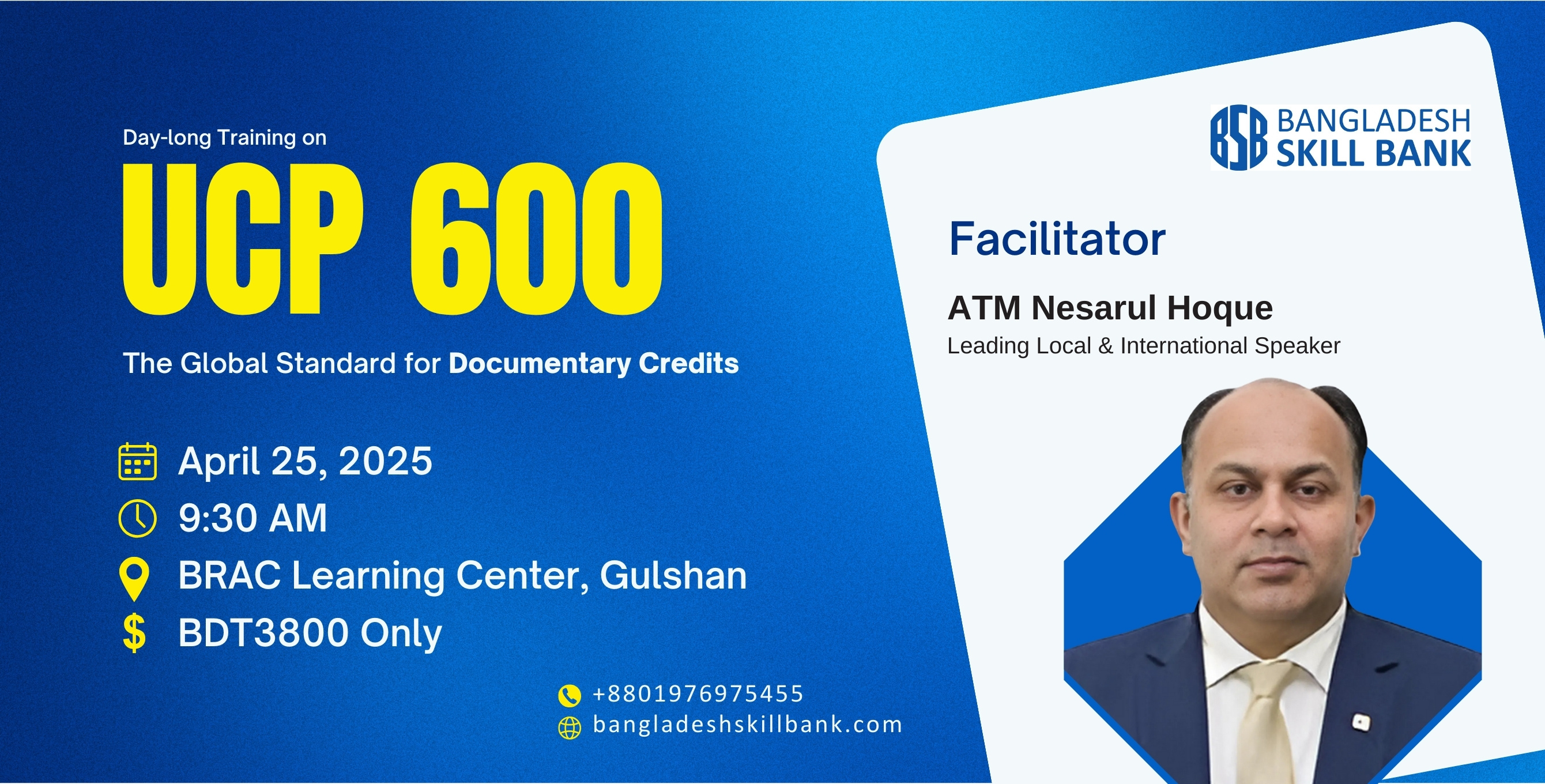
Cost: 6000.00 BDT
3800.00 BDT
Course Features
Lectures: 1
Duration: 8 hours
Skill Level: All
yyyyy
No curriculum available.
Training Overview
This is an interactive and practical workshop designed to provide a comprehensive understanding of the key provisions of UCP 600. The program is structured to categorize the provisions of UCP 600 into six main areas: issuance, advising, amendment, documents, presentation, examination, and settlement. This organization allows participants to easily connect relevant provisions with the functions of documentary credit. Each session will not only clarify the respective UCP 600 provisions but will also include numerous examples, ICC Official Opinions, court cases, and practical tips. This combination of theoretical and practical insights -basic interpretations of the rule, examples, related ICC official Opinions, DOCDEX decision, and court cases- will make the full-day workshop highly valuable.
Training Objectives:
After completing the training, participants will achieve the following four key objectives:
Understand the key provisions of UCP 600
Gain a comprehensive understanding of documentary credit operations from operational and legal perspectives.
Able to apply gained knowledge to daily operations and helps the company in better risk management and cost savings.
Will be capable to form own team and train them accordingly.
Brief outline of each sessions
Brief background of the UCP:
A conceptual session will explore key terms and fundamental principles of the documentary credit business. This session will lay the groundwork for the remainder of the day. One of the key points of this session is that participants will understand how the documentary credit business is distinct from the sales contract, even though the documentary credit is based on that contract.
Credit availability and undertaking of the issuing bank, confirming bank and nominated bank
The concept of credit availability is central to the operation of documentary credits. It refers to the process of receiving payment upon a compliant presentation of documents. While UCP 600 clearly outlines the obligations of the issuing bank and the confirming bank to the beneficiary in the case of a compliant presentation, the role of the nominated bank under UCP 600 is somewhat more nuanced. Typically, the nominated bank functions as a trusted intermediary between the issuing bank and the beneficiary, without assuming any independent obligations under the credit. This session will focus on addressing these issues.
Disclaimer, tolerance and presentation to an extended expiry date
Banks manage the overall documentary credit operation at a representational level, which is separate from the factual level. They make payments based on the apparent compliance of presented documents without verifying the authenticity of those documents. To facilitate this level of operation, UCP 600 includes several strong disclaimers to protect the banks. This session will address this issue in detail. Additionally, Article 30 of UCP 600 specifically addresses tolerance issues related to amount, quantity, and unit price. This session will thoroughly examine this concept. There may be situations where the beneficiary is unable to present documents to a designated nominated bank due to circumstances beyond their control, other than force majeure. This session will also discuss the appropriate course of action in this scenario.
Documents under documentary credits: ways to look at
Commercial invoices, transport documents, and insurance documents are the three primary documents for which UCP 600 has specific provisions. All other documents are categorized as "other documents." Participants will gain a comprehensive understanding of the requirements for these documents during the examination. Additionally, they will receive practical advice on drafting the credit conditions for "other documents" to prevent potential disputes later in the documentary credit process.
Examination and Settlement
Examining documents under UCP 600 is more of an art than a science. Banks must adhere to specific rules and operate within established boundaries to determine whether a presentation is compliant. When a presentation is compliant, the roles of the issuing bank, confirming bank, and nominated bank are clearly defined in UCP 600, Article 15. This session will outline the standard processes that banks should follow to comply with UCP 600.
Additionally, we will discuss the steps a bank should take when a presentation is not compliant. If a bank decides to refuse a presentation, it is essential to send a notice of refusal. Failure to provide adequate and timely notice of refusal will invoke the preclusion rule. This session will also delve into the nuances of the "notice of refusal" and will train participants on how to prepare a notice of refusal that aligns with UCP 600, Article 16.